The EU Commission: Democracy's Facade – Legislation Without the People's Voice
Øyvind Snekkestad, May 27, 2025
The EU is described as a democratic community. Yet the very core of the Union's legislative process, the Commission, has striking similarities to governance structures we know from authoritarian systems like China and the former Soviet Union. When Norway's EU supporters claim that we should join to 'gain more influence,' the question should rather be: Does real influence even exist in a system where the people never get to initiate policy?
The EU Commission: Sole Authority for Legislative Proposals
In the EU, it is not the elected representatives in the European Parliament who introduce new laws. It is the European Commission, an appointed body that has primary responsibility for proposing all new EU legislation. This is not a loose practice, but a formal rule in the Lisbon Treaty:
"Union legislative acts may only be adopted on the basis of a Commission proposal, except where the Treaties provide otherwise. Other acts shall be adopted on the basis of a Commission proposal where the Treaties so provide."
– Treaty on the European Union, Article 17(2)
This means that no new EU laws can be adopted unless they first come from the Commission. Although the European Parliament can discuss and vote on proposals, they generally cannot submit draft legislation themselves. The Commission does not consist of elected officials, but of commissioners appointed by member states' governments, and their loyalty is formally to the Union, not to their own nations. Thus, an unelected body has been given a key role in the political governance of the entire Union.
This loyalty to the Union is not merely symbolic; it is legally anchored in the treaty itself. In the same article, the Commission's institutional independence is emphasized:
"In carrying out its responsibilities, the Commission shall be completely independent. Without prejudice to Article 18(2), the members of the Commission shall neither seek nor take instructions from any Government or other institution, body, office or entity. They shall refrain from any action incompatible with their duties or the performance of their tasks."
– Treaty on the European Union, Article 17(3)
This underscores that the Commission is a supranational actor that is not accountable to any national democracy. It acts on behalf of the Union's interests, as the Commission itself defines them.
The Commission's role is often presented as a neutral administrator of common European interests. But in practice, this monopoly means that Europe's citizens do not have a real opportunity to initiate new legislation through their elected representatives. The European Parliament can discuss and vote on legislative proposals, but it has essentially no independent right of initiative. In certain exceptions, the Parliament may request that the Commission submit a proposal, but the Commission is free to refuse. This so-called 'right of initiative' therefore functions more as a recommendation than a tool for actual influence.
This creates a situation where elected parliamentarians do not have structural control over policy development, but only the opportunity to approve or reject proposals that come from above. The democratic deficit is reinforced by the fact that there is also no obligation for popular follow-up or consequence when the Commission rejects Parliament's wishes. The initiative, which is the very spark in a living democracy, lies not with those who choose or are chosen, but with a bureaucratic body without direct accountability to voters.
This monopolization of the right of initiative contradicts the fundamental idea of representative democracy, where elected officials should be able to influence society's development on behalf of their voters. When not even national parliamentarians have influence over which EU laws are proposed, a serious democratic deficit is introduced into the structure itself.
There is a widespread misconception that the Commission's role is limited to technical or administrative regulations. In reality, it is the Commission that initiates many of the most society-shaping and value-laden proposals in the EU, including directives on climate, digitalization, migration, and the economy. These are policy areas that in most countries would be subject to broad democratic debate and initiative from elected officials.
By maintaining its monopoly on legislative proposals, the Commission acts as an unelected and supranational law-making machine, where the democratic impulse must be filtered through a bureaucracy that is not directly accountable to Europe's citizens. This makes the EU a unique system among Western states. When the Commission controls which laws are introduced, and elected officials cannot set the agenda, citizens' role is limited to adapting to decisions they never had real influence over.
Western Democracies: Multiple Rights of Initiative
In traditional Western democracies, it is a fundamental principle that all elected representatives have the right to introduce legislation. This ensures an open legislative process where different social groups and political perspectives can directly influence policy through their representatives, and not just vote on finished proposals.
In Norway, all Storting representatives have a constitutionally guaranteed right to introduce legislation, cf. the Constitution §76. This applies regardless of party size or whether the representative is in government or opposition. In addition, the Storting's Rules of Procedure (§30) provide specific procedures for so-called private member bills. This right ensures that the legislative process remains open, diverse and accessible, and that minorities and individual representatives can also set the political agenda.
In the USA, all members of both the Senate and the House of Representatives have the right of initiative. Each proposal, a so-called bill, is considered through committee work, debate and voting, regardless of which side of the aisle it comes from. The system presupposes that elected officials do not just vote yes or no, but also actively participate in shaping legislation.
In Germany and France, parliamentarians have independent right of initiative alongside the government. In France, there is a distinction between projets de loi (government proposals) and propositions de loi (parliamentary proposals), while in Germany both the Bundestag, the Bundesrat, and the government can initiate new legislation.
This right to introduce legislation is more than a technicality. This right is a guarantee that the people, through their elected representatives, can set the political agenda. When this right is removed or restricted, power shifts away from voters and into the hands of a more closed system. This is precisely what makes the EU model, with a sole-authority commission, so problematic from a democratic perspective.
Historical Parallels: The Soviet Union and China
After seeing how elected officials in Western democracies have real right of initiative, it becomes particularly striking how similar the EU's structure is to the governance systems in former and current one-party states.
Both the Soviet Union and the People's Republic of China have had constitutions that formally give parliaments legislative authority, but in reality the power to initiate and control laws lies with the party's supreme organs.
In the Soviet Union's constitution (1977), Article 6 states:
"The leading and guiding force of Soviet society and the nucleus of its political system, of all state and public organizations, is the Communist Party of the Soviet Union."
– USSR Constitution, 1977
Similarly, China's constitution (2018) states in Article 1:
"The defining feature of socialism with Chinese characteristics is the leadership of the Communist Party of China."
– Constitution of the PRC, 2018
Both constitutions emphasize the party's role as the core of the state. The parliaments, the Soviet Congress and the Chinese National People's Congress (NPC), have legislative power on paper, but in practice only those laws already approved by the party's politburo are introduced. The right of initiative is thus not democratically anchored, but filtered through a closed party system.
This type of power structure means that the parliaments in China and the former Soviet Union in practice only approved what had already been decided by the party's top leadership. Elected officials had little or no influence on what would become law. When we look at the EU, we find a similar mechanism. The Commission, which is an unelected body, determines which laws are to be proposed, and the Parliament can only take a position on what has already been selected. There is no channel for voters to influence the content of legislation before it is formally initiated.
Although the EU is not a one-party state, the system functions in practice so that democratic influence is absent at the very starting point of legislation. The Commission, a bureaucratic body appointed by governments but loyal to the Union, sets the agenda without voters or their representatives having any real influence on what is proposed. This makes the Commission a governing body reminiscent of the politburo in China or the Soviet Union. It defines which questions are to be addressed and leaves little room for independent political initiative. In this comparison, one sees that it is the structure that reveals where power actually lies.
A Power Structure We Recognize
When elected officials cannot propose laws, and all new policy must be approved or initiated by a closed body, then we move away from classical democracy. This is precisely what characterizes both the EU Commission and the political systems in China and the former Soviet Union:
Power is moved upward, away from voters, and concentrated in a small group without direct accountability. What they call cooperation in the EU, they called unity in the Soviet Union, and in China they call it stability.
But the result is the same:
The people's representatives vote on something they have not been involved in shaping.
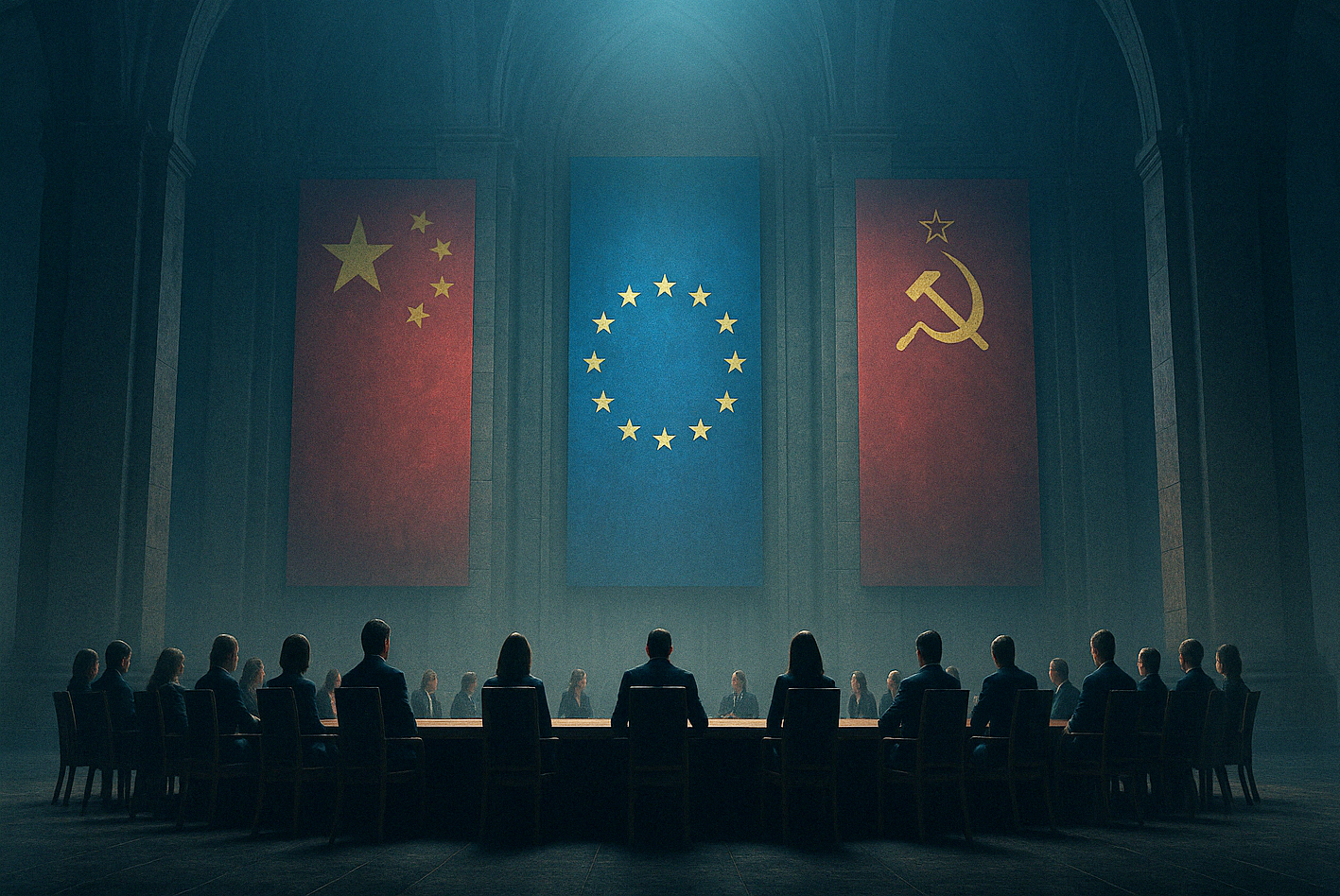
The difference lies only in colors and symbols. Where one-party states have uniforms, flags with stars and central committees, the EU has a blue flag, a technocratic commission and directives. The language and surfaces are democratic, but the process is bureaucratic and top-heavy.
This does not make the EU an authoritarian state in the traditional sense, but it makes the structure vulnerable to authoritarian features. When decisions do not arise in elected assemblies, but come fully formulated from the top, the space for political initiative, debate and popular resistance disappears. A system is created where one can only vote on proposals, but not shape them.
And yet we hear that Norway should join the EU to "gain more influence.
But what influence is there really to gain in a system where even the elected representatives in the EU do not have the right to propose laws?
To ask for a seat at the table means little if the table has already been cleared of debate.
Directives or Laws? A Semantic Difference
The EU does not adopt "laws" in the classical sense, but uses terms such as directive, regulation and decision. This gives the impression that the EU only sets overarching guidelines, but in practice these acts function as binding legislation.
A directive must in principle be implemented in national law, for example through new legislation or regulation. Nevertheless, practice shows that Norwegian authorities and courts in some cases have used EU directives as legal basis, even in cases where these directives were not formally incorporated into Norwegian law. Member countries thus have little real room for maneuver, either in content or in practical legal application. If implementation does not happen quickly enough or correctly, the country can also be convicted in the EU Court of Justice.
Regulations go even further, as they enter into force immediately and apply directly in all member countries without the need for national treatment. This makes EU regulations a supranational legal system, without the flexibility and popular anchoring found in national democracies.
In Norway, this has particularly serious consequences. As an EEA member, we are legally bound to large parts of EU regulations, but without having voting rights in any of the institutions. We neither appoint commissioners nor have representatives in the Council of Ministers. We have observer status in the European Parliament, but no real influence over the directives that must be followed.
This means in practice that EU decisions apply as law in Norway, and without any Norwegian or European citizens having had democratic influence over what was proposed. When only the Commission can initiate legislation, both member states and associated states stand without real influence on the content.
In some cases, EU directives have subsequently collided with Norwegian law and practice, and been given precedence, even though Norwegian authorities believed they were acting within existing law. Several people were convicted of violating Norwegian law in accordance with how the regulations were then understood and practiced. But later, EU/EEA rules have been applied as if they had always had precedence, and in some cases this has led to acquittals or reversals. This leaves an impression that it was the Norwegian legal situation itself that was the problem. It was not the violations that were the problem, but that it was the EU regulations that represented the true justice. When decisions that have not been processed by the Storting take precedence in the Norwegian legal system, both legal security and the very idea of national legislative power are weakened.
Where is the EU Going?
The EU has evolved from an intergovernmental trade cooperation into an increasingly comprehensive political project. With the Lisbon Treaty and a steady stream of new directives and regulations, the Union has stepped up its role in areas such as climate, health, digital identity, migration and security policy. This development happens without the decision-making model itself being changed. The Commission retains the right of initiative, and citizens are kept at a distance from the very starting point of legislation.
At the same time, the Commission has begun to take a more prominent role externally. It is the Commission that speaks on behalf of the EU in international climate negotiations. It is the Commission that negotiates trade agreements and regulates the energy market. Now the Commission is also gradually taking a more unifying role in Europe's security policy, especially in light of the war in Ukraine and the uncertainty surrounding the USA's future NATO commitment. Increasingly, the Commission functions as a supranational government, but without the parliamentary control and popular anchoring that otherwise comes with such power.
The Union's direction points toward increased integration, but what is being integrated is regulations, bureaucracy and decision-making power, not democratic participation. When the Commission gets ever greater responsibility, but not greater accountability, a vacuum arises. Power accumulates at the top, but the people are left without insight, influence or the ability to hold anyone accountable.
Many critics of the EU are often labeled as backward or nationalistic. But this is not about nostalgia. It is about protecting what we still have. Norway stands outside the EU, and although the EEA agreement binds us to large parts of EU legislation, we still have a national popular government. The Storting still has the right of initiative in many areas, and that is a right we should not take for granted.
When power over new laws is moved to an appointed group of bureaucrats, and elected officials only get to take a position on finished proposals, democracy is weakened at its core. Such a system, no matter how modern or European it appears, can hardly be called democratic.
Influence in a System Without Influence
When the EU Commission alone controls what can become law, and when this power is constantly expanded to new policy areas, what should be democracy's core disappears—the opportunity elected officials should have to represent and shape society's direction.
Yet we hear in the Norwegian EU debate that "we must join to gain influence." But influence in a system where even member countries' parliamentarians cannot introduce legislation is not real power. It is only participation in an apparatus where the big decisions have already been made. One may get to sit in the room, but is far from shaping the agenda.
The EU presents itself as a modern, liberal and responsible project. But the structures resemble more those we know from authoritarian systems, where there is centralization, an initiative monopoly, and a large absence of popular anchoring. When power is concentrated with unelected commissioners, and directives override national law without being democratically anchored, we lose what makes politics more than administration—the possibility of choice, accountability, and changing course.
This is not a critique of cooperation, but it is a critique of governance structure.
For without real right of initiative and popular control, there is no democracy. It becomes just a system that gives the impression of participation, but which in practice is governed from above.
Can we call it democracy when the initiative never comes from the people? What good is voting when none of the elected get to propose? If elected officials cannot initiate legislation, who then governs democracy?
References
- European Union. (2012). Consolidated version of the Treaty on European Union (TEU). Official Journal of the European Union, C 326. https://eur-lex.europa.eu/legal-content/EN/TXT/?uri=CELEX:12012M017
- Grunnloven. (1814/2024). Kongeriket Norges Grunnlov. Lovdata. https://lovdata.no/dokument/NL/lov/1814-05-17
- Stortinget. (u.å.). Forretningsorden for Stortinget § 30. https://www.stortinget.no/no/Stortinget-og-demokratiet/Lover-og-instrukser/forretningsorden
- USSR. (1977). Constitution (Fundamental Law) of the Union of Soviet Socialist Republics. http://www.departments.bucknell.edu/russian/const/77cons01.html
- National People's Congress of the PRC. (2018). Constitution of the People's Republic of China (Full Text after Amendment on March 11, 2018). https://npcobserver.com/wp-content/uploads/2023/11/PRC-Constitution-2018.pdf