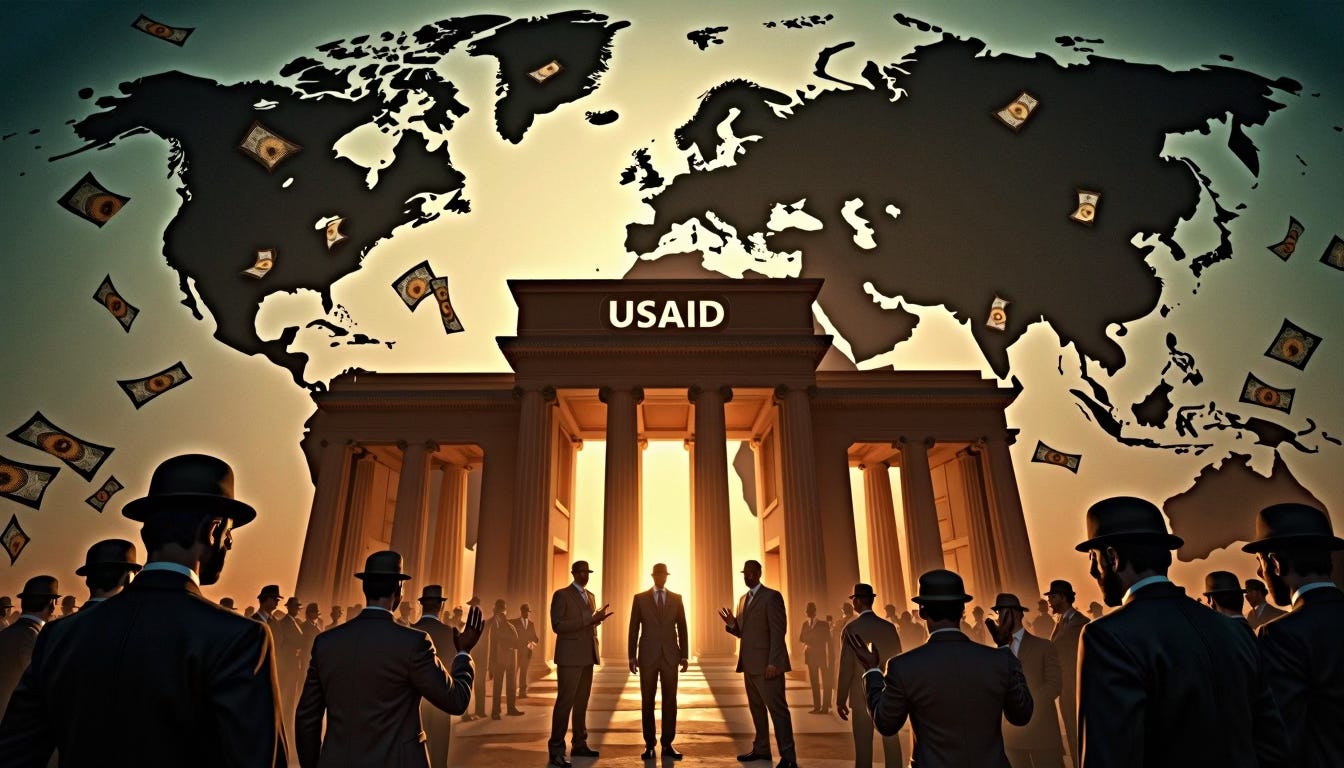
USAID and Economic Hitmen
Øyvind Snekkestad, March 7, 2025
USAID (United States Agency for International Development) has long been a tool for American development aid, but also a means of advancing U.S. geopolitical interests. In the book Confessions of an Economic Hit Man, John Perkins describes how USAID, in collaboration with international financial institutions such as the World Bank and the IMF, has been used to manipulate developing countries into economic dependency. The Trump administration has faced criticism for cuts to emergency aid and for its intervention in USAID's operations. Elon Musk and his role in the Department of Government Efficiency (DOGE) have been particularly criticized for exposing waste and dismissing USAID employees. DOGE claims that USAID has been involved in projects they consider meaningless, ineffective, and irresponsible.
Perkins, who previously worked as an economic hitman (EHM) for private companies closely tied to USAID-funded projects, describes in his book how development aid has often been part of a larger geopolitical game. According to Perkins, the real purpose of many of the enormous loans and projects initiated through USAID was not to help developing countries, but to secure American dominance over global resources, particularly in areas rich in natural resources or strategically located.
During his time as an EHM, Perkins was trained to create economic forecasts that justified large loans to developing countries, often for infrastructure projects such as power plants, roads, and ports. These loans were then conditioned on being used to pay American companies that won the contracts. As countries became trapped in debt, the U.S. and its multinational corporations could extract economic and political advantages from these exhausted nations.
USAID, which on the surface appeared to be an aid agency, actually functioned as a tool to support American companies involved in international construction projects. In this way, USAID became one of the key instruments for maintaining the American economic empire, as Perkins describes it, and there was a connection between these projects and the economic hitmen who sought to burden countries with debt and secure resources for the U.S.
International Financial Institutions: The World Bank and the IMF
In addition to USAID, Perkins highlights other important actors closely tied to the economic empire he describes, particularly the World Bank and the IMF (International Monetary Fund). Perkins describes how these institutions have been involved in a global financial system that benefits wealthy nations, especially the U.S., while exploiting developing countries.
The World Bank and the IMF have been the primary channels for loans to developing countries, and Perkins demonstrates how these loans were often provided under conditions that compelled countries to implement economic reforms that favored international corporations and wealthy nations. In practice, according to Perkins, many of the loans from the World Bank and the IMF were designed to create economic dependency rather than help poor nations achieve independent growth. The loans were often intended for infrastructure projects—projects burdened with unnecessarily high costs that ultimately trapped countries in a perpetual debt spiral.
For example, when the World Bank provided a loan to a country to build a power plant or road, these loans were often conditioned on using American companies to construct and manage these projects. The result was that money meant to help developing countries was instead channeled back to the large American corporations involved in these projects. This left developing countries with an enormous debt burden that they struggled to repay.
The IMF has also been a key actor in maintaining this economic power balance. Perkins describes how IMF requirements often included "structural adjustment programs" that forced countries to cut public spending, privatize national resources, and open their markets to foreign investment—all to the benefit of multinational corporations, often American, that would operate in these poor countries.
Elon Musk, DOGE, and USAID in Mainstream Media
USAID has also been involved in projects that favor American companies through partnerships with NGOs (Non-Governmental Organizations). In some cases, USAID, in collaboration with NGOs, has helped implement economic strategies that have increased poverty rather than reduced it. Perkins' descriptions of how economic hitmen in the 1970s and 1980s exploited financial tools such as loans and aid from such organizations to facilitate economic dominance remain relevant.
Elon Musk's Department of Government Efficiency (DOGE) has uncovered patterns in USAID's aid work that resemble what John Perkins described in Confessions of an Economic Hit Man. Large sums have gone to administrative costs, consulting services, and meaningless projects.
John Perkins' description of economic hitmen as a tool for advancing U.S. interests remains relevant in today's geopolitical landscape. Economic hitmen in his time operated behind the scenes to manipulate economies to serve American interests, while today more visible actors such as USAID and NGOs, in some cases, continue to play a similar role.
While the old methods Perkins described may seem more direct and covert, today's version is more polished, with financial tools and international aid organizations serving as front figures. The major difference lies in how today's policies, led by figures like Donald Trump and Elon Musk's DOGE, challenge the established order. The revelations and review of USAID have been heavily criticized in mainstream media, where the focus has largely been on the consequences of DOGE's actions—such as mass layoffs and reduced emergency aid to crisis-affected areas—rather than on the ineffective and meaningless projects that have been exposed. Such one-sided coverage in mainstream media is not necessarily wrong, but it omits important aspects of USAID's role and spending.
References
- Perkins, J. (2004). Confessions of an Economic Hit Man: The Shocking Story of How America Really Took Over the World. Berrett-Koehler Publishers.